Call a licensed agent: 833-964-9663
Home » Car insurance » How Car Insurance Comparison Sites Work
Comparing car insurance quotes can help you find the lowest rate. Learn the different types that are out there, and which sites offer you the best results.
Fetch the best rates for the right coverage, no sign up required!
"*" indicates required fields

Shopping for car insurance online can feel like an overwhelming process. There are so many insurance companies out there and each one will give you different rates based on several personal factors, so it can be difficult to even know where to begin. This is where car insurance comparison sites come into play.
Car insurance comparison tools exist to help you find the cheapest car insurance rate possible by allowing you to compare insurance companies side by side. Often, comparison sites display either direct quotes or rate estimates based on your answers to questions such as how old you are, what state you live in, and what type of car you drive.
However, not all car insurance comparison sites are created equal, and understanding all the different options out there is an essential part of finding your cheapest car insurance rate — and ensuring your personal information is safe and you’re not spammed into oblivion.
Want to compare 10+ rates now?
Start saving on car insurance in minutes.
No phone or email required. Seriously.
Car insurance comparison sites are meant to solve a problem long plaguing the car insurance industry: comparing rates is the only way to get the cheapest price on car insurance, but getting quotes from all the top companies individually is tedious and time-consuming. Comparison sites promise to fix this.
At their core, most function the same way:
If you’re looking to compare car insurance companies side by side, there are four main types of comparison websites you might come across: insurance marketplaces, insurance brokers, quote aggregators, and lead-generation platforms. Each can help you find and compare insurance companies (usually for free, since most of these sites make money through referrals of some kind), but each has its own strengths and weaknesses.
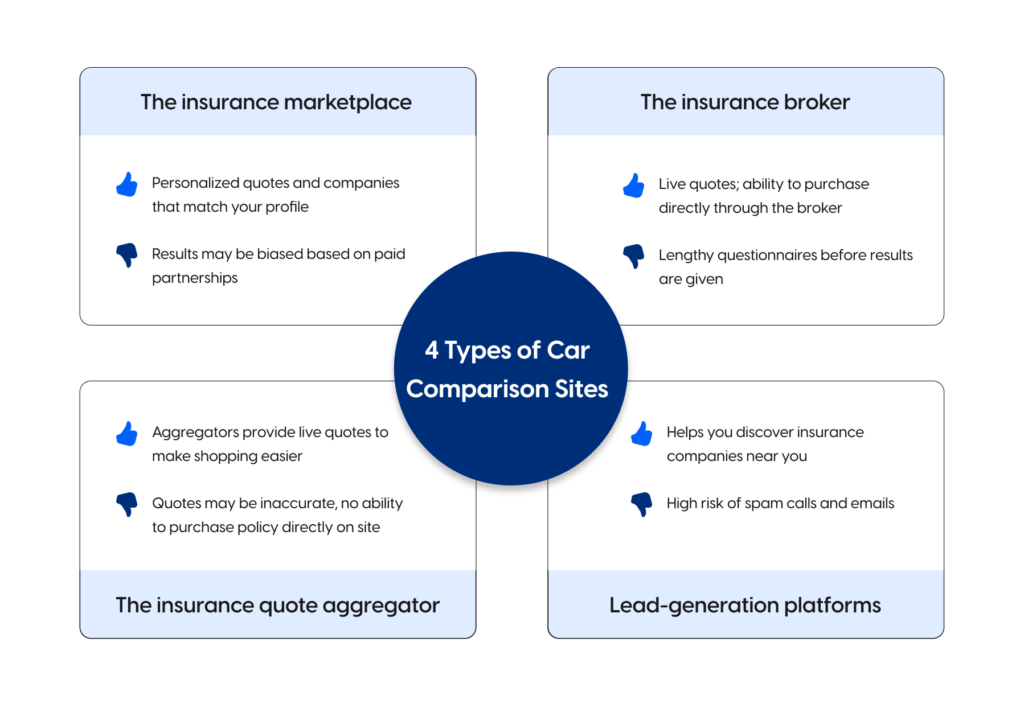
After you answer some personal questions, this kind of comparison site will display your personalized results (usually quotes or top companies that match your profile). This type of comparison tool makes money through commissions or referrals, so when you click on an insurance company’s website from the results page, the marketplace earns a commission.
The very best of these tools will not require contact information to view your results, but for the ones that do, there is a risk of spam phone calls, emails, and text messages for the user.
Usually, this kind of site works directly with a handful of insurance companies, and will only be able to tell you about the companies they work with (and they certainly can only give you quotes for the companies they work with). Because of this, your results will be limited to the ones the site works with in your state.
Pros:
Cons:
Insurance brokers make money through commissions. Once the user fills out the questionnaire on the broker’s site, the broker will connect them with an agent who can recommend a provider. Every time a customer purchases a policy or clicks on a sponsored or affiliate link on the broker’s website, the broker gets paid.
Like marketplaces, brokers can only get quotes from insurance companies they partner with, and they usually only tell you about your options with these companies too. If you want to discover other companies, you’ll have to go somewhere else.
Pros:
Cons:
Quote aggregators use a system called Rate Call 1 to offer consumers live quotes from the insurance companies that they partner with, but users only get those results after answering a fairly in-depth questionnaire. These types of comparison sites primarily rely on affiliate links to make their money, however, some of these sites also sell user contact information, making them high risk for spam.
Pros:
Cons:
Lead generation platforms collect your personal information, then show you ads for their sponsored partners in your location. Instead of getting matched with personalized rates or live quotes, these platforms primarily display ads. The number of ‘results’ you see will depend on how many companies want to advertise to your profile. So if you have an attractive driver profile (for example, multiple drivers, currently insured, or in a desirable state), you’ll get served more ads. The site will generally give the top slot on their results page to the advertiser who bid the most money for your click.
While these types of sites make a profit through affiliate and sponsor links, they also sell “lead data” (the information you submit in the quiz) to outside sources. This makes lead-generation sites incredibly high risk for spam.
Additionally, platforms that follow this model do not offer comprehensive results, as they only display ads for their sponsored insurers in your location instead of showing personalized rates or live quotes.
Pros:
Cons:
 Rate Retriever: the true insurance comparison tool
Rate Retriever is a new kind of insurance comparison tool that doesn’t perfectly fit into any of the above categories. When we designed our tool, our goal was to create the only true insurance comparison tool on the market, and with Rate Retriever, we have done just that. Now, we’re aware that we might be a little biased on that front, but our customer reviews don’t lie.
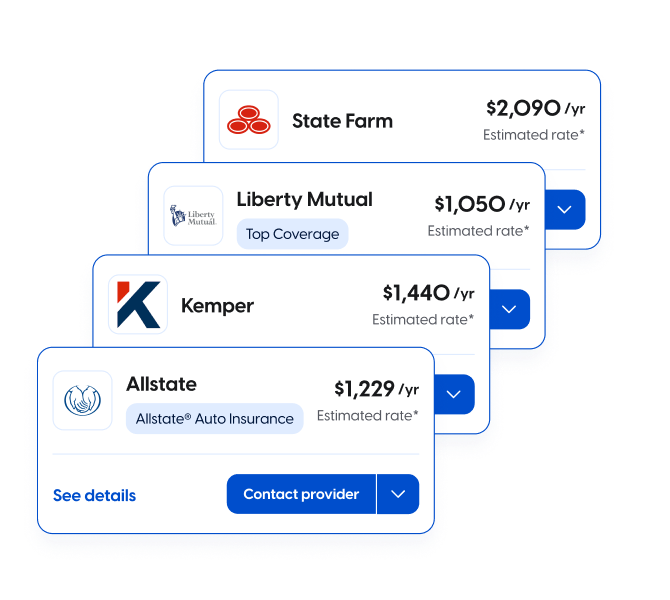
Unlike an insurance marketplace, you cannot purchase a policy directly through Rate Retriever, rather our tool empowers you to independently research your insurance options and we’ll seamlessly connect you with the provider of your choice. Based on your answers to our quick quiz, we’ll find your best options and give you rates for as many companies as we can. Even if we can’t provide you a rate, we can show you the companies in your area that might be worth checking out.
One of our core priorities when creating Rate Retriever was to keep our tool 100% spam free, so we never require your phone number or email address before displaying results.
Another foundation we built our tool on was complete transparency with our users. In the spirit of that, we’ll tell you that we do primarily make money through commissions gained when a user clicks on or calls one of our insurance provider partners or purchases a policy.
We combed through the most well-known players in the insurance comparison space and ranked them so that you don’t have to. To reach our conclusion, we evaluated several factors including user experience, risk of spam, and the variety and relevancy of results. Essentially, we’re looking for a balanced tradeoff between the amount of work the user has to put in and the quality of the experience and the results they receive.
We consider a “good” comparison site one that:
In our minds, a good comparison site is quick, easy, unintrusive, and gives quality results you can compare.
Based on that definition, we evaluated and ranked the top insurance comparison websites in 2026.

Now we can admit we are biased, but based on our analysis of the most popular insurance comparison tools, Rate Retriever takes the top spot on our list. This is why:
Was it quick? Clocking in at 2-3 minutes, Rate Retriever featured one of the fastest quizzes of the car insurance comparison sites we tested.
Was it unintrusive? Rate Retriever didn't ask for phone number or email, and the quiz didn't ask any invasive or confusing questions. The only personal information it collected was physical address and name, which car insurance companies use to give you accurate quotes.
Did it return quality results you can compare? Yes, Rate Retriever came back with multiple rates and additional companies to consider for every profile we tested.
Our favorite thing about Rate Retriever: Provided real rate estimates directly on the results page without requiring user contact information.
Our least favorite thing about Rate Retriever: Results provided are only estimates, so your actual rate could look different.
#2 on our list is an insurance marketplace, The Zebra. This tool snags the second spot because it gave a relatively large number of options at the end, as well as some additional comparison features on its results page. If your profile matches what one of their insurance provider partners is looking for, you should see live quotes returned.
Was it quick? The Zebra was actually one of the longer, more involved quiz flows we tested, but we felt the quality of the results made up for this.
Was it unintrusive? The Zebra did require all your contact info, and it asked questions that seemingly have little to no impact on your initial quotes for car insurance, which made the quiz longer without making the value of those answers clear.
Did it return quality results you can compare? Yes, The Zebra came back with multiple rates and additional companies to consider for every profile we tested except one, which only had one rate returned.
Our favorite thing about The Zebra: Displays a good number of results and has a unique results page with bonus features to help you decide.
Our least favorite thing about The Zebra: Your experience will vary depending on if they have a relationship with a company that wants to serve your profile.
Insurify is another online insurance marketplace, and it had a moderate length quiz, pretty similar to others on this list. Its quiz was easy, the results page provided a good number of insurance providers, and it did offer quotes for every profile we tested.
Was it quick? Insurify was in the middle of the road for car insurance comparison sites we tested when it comes to quiz length and speed.
Was it unintrusive? Insurify did require all your contact info, and it asked a few questions that seemingly have little to no impact on your initial quotes.
Did it return quality results you can compare? Yes, Insurify came back with multiple rates and additional companies to consider for every profile we tested.
Our favorite thing about Insurify: Quotes are available directly on the results page.
Our least favorite thing about Insurify: Requires user contact information before showing results.
Jerry Insurance is an online insurance broker and mobile app. This tool takes the fourth spot on our list because for every profile tested, Jerry returned the most quotes to compare (besides Rate Retriever). Jerry can also sell you a policy directly through their site, and their app has some additional benefits like price tracking and automatic shopping every 6 months.
However, the key downside to Jerry is that you cannot access your results at the end of the comparison quiz without downloading their app and using your phone number to sign into your account.
Was it quick? Jerry took by far the longest time to reach your results because you have to create an account and download their mobile app to see your quotes.
Was it unintrusive? Jerry asked a lot of questions including all contact info and required you to create an account and download their app, so we cannot say it was unintrusive.
Did it return quality results you can compare? Yes, Jerry came back with more quotes to compare than The Zebra or Insurify (but not Rate Retriever).
Our favorite thing about Jerry Insurance: Quotes from real insurance companies for every profile tested.
Our least favorite thing about Jerry Insurance: You need to download their app in order to view your results.
This site categorizes themselves as an insurance quote aggregator, relying primarily on affiliate and sponsor links to make a profit. The length of the initial quiz was average and it did not require your phone number before displaying results. While it only returned one result for each profile we tested, it was always a real quote from a reputable insurance provider.
Was it quick? While not the quickest quiz on our list, Bankrate was fairly quick to complete.
Was it unintrusive? While it did ask for your name, address, and email, the rest of Bankrate's quiz felt pretty unintrusive.
Did it return quality results you can compare? Not really. While the quote it returned was from a reputable provider, there was only one option, so no real chance to compare.
Our favorite thing about Bankrate: Provides at least one quote without requiring phone number.
Our least favorite thing about Bankrate: For the profiles tested, results did not offer a "comparison" experience, since there was only one option returned.
Compare.com is a decent option for a comparison site. It offers a moderate-length quiz and returned a handful of results, including some quotes, for most of the profiles we tested. There is a spam risk since contact info is required, but that is a tradeoff for most sites on this list.
The reason we ranked Compare.com below others like Bankrate is that it clearly biases its results to sponsored ads. Once you reach the results page, you’ll only be showed two ads until you click “See more.” At that point, all results will come up, including any rates it found for you.
Was it quick? Compare.com's quiz was middle of the road in terms of quiz length and time to complete.
Was it unintrusive? Compare.com does require phone, email, address, and name to complete.
Did it return quality results you can compare? Yes, though you'll have to expand your results page to see them all. We did not get quotes for every profile we tested.
Our favorite thing about Compare.com: Provides a good list of insurance companies at the end of the quiz.
Our least favorite thing about Compare.com: It doesn't show you all of your results (including the rates) unless you click "See More" at the bottom of your results page.
Find the Right Car Insurance for You
Insure.com is the beginning of the bottom of our list. It beats out the others because it provided the most results on average for the profiles we tested, though none received any rates. There’s a spam risk with the site because it requires phone and email and may sell your contact info to their partners.
Was it quick? Insure.com was one of the quicker quizzes we tested.
Was it unitrusive? No, Insure.com required phone and email as well as several other pieces of personal information. This site is a high spam risk.
Did it return quality results you can compare? Insure.com gave multiple results, but no rates.
Our favorite thing about Insure: The results offer a few options for you to consider.
Our least favorite thing about Insure: Users are redirected to provider websites to see their quotes.
This lead-generation comparison site belongs to Lending Tree. It lands at #8 on our list because while it offers consumers a quiz that took about as long as the other sites tested, the results page returned only 1-2 results. Value Penguin also could not provide an actual quote or rate estimate, and required contact information before displaying results.
Was it quick? Value Penguin's quiz was fairly quick.
Was it unintrusive? Value Penguin did require phone and email to see your results. This site is a high spam risk.
Did it return quality results you can compare? Value Penguin gave a few results, but no rates.
Our favorite thing about Value Penguin: Quiz wasn't hard to complete.
Our least favorite thing about Value Penguin: Results did not include any rates and were almost exclusively other comparison sites.
Otto is considered a lead-generation insurance comparison website. It lands at #9 on our list because it only offered 1-2 results, but no rates. After the initial quiz (which was an average length) the results page did not display any actual quotes or rate estimates. Additionally, the tool requires user contact information before generating results.
Was it quick? Otto's quiz was the fastest one we tested.
Was it unintrusive? Otto did require phone and email to see your results. This site is a high spam risk.
Did it return quality results you can compare? Not really, Otto gave a 1-2 results, and no rates.
Our favorite thing about Otto Insurance: Offers a straightforward and moderate length quiz experience which was the quickest for our testers to complete.
Our least favorite thing about Otto Insurance: The initial results page only provides one option, and it does not include rates.
PolicyGenius is another example of an insurance marketplace. The reason we ranked it last is that while the quiz experience was longer than most others on this list, it yielded unimpressive results. At the end, the user is provided with several insurance companies to choose from, however, no quotes or rate estimates were immediately available on the results page. The quiz also requested user contact information before it displayed the results.
Because the quiz was time-consuming and at times confusing to complete, we expected the tradeoff of at least two quotes to compare. PolicyGenius was unable to provide rates for any of the profiles we tested, so we decided that the effort to output was the worst of the sites we reviewed.
Was it quick? PolicyGenius had the longest quiz we tested by far.
Was it unintrusive? PolicyGenius asked the most questions and the most detailed, personal questions of any other site on our list. It also required your name, phone, email, address, and license information. It felt by far the most intrusive quiz we tested.
Did it return quality results you can compare? PolicyGenius did not offer any rates for the profiles we tested. Otherwise, it gave several results to consider.
Our favorite thing about PolicyGenius: Provides multiple results you can consider.
Our least favorite thing about PolicyGenius: The quiz took too long and asked for too much for a site that does not provide actual quotes for the average profile.
Shopping for car insurance online can feel like an overwhelming process. There are so many insurance companies out there and each one will give you different rates based on several personal factors , so it can be difficult to even know where to begin. This is where car insurance comparison sites come into play.
Car insurance comparison tools exist to help you find the cheapest car insurance rate possible by allowing you to compare insurance companies side by side. Often, comparison sites display either direct quotes or rate estimates based on your answers to questions such as how old you are, what state you live in, and what type of car you drive.
However, not all car insurance comparison sites are created equal, and understanding all the different options out there is an essential part of finding your cheapest car insurance rate.

According to our 2025 report, the national average for car insurance is $2,110, but every driver’s specific rate will vary based on several different factors, such as your zip code, vehicle, and driving history. Car insurance rates continue to rise faster than most else in the economy. Under the influence of inflation, production shortages, increased theft and accident rates, and more, car insurance is more expensive than ever before.
But because car insurance rates are specific to you, the price you’ll pay with one insurance company may vary widely from the price you’d pay at another.
No matter which tool you use, comparison shopping is the most effective way to view all the best car insurance companies in your area and be sure that you are getting the coverage you need for the lowest price available to you.
There are some terms we use when describing car insurance comparison sites and how they work that you may not be familiar with or that we use in a different way than their normal definition. This glossary is meant to define our terms and clear up any confusion for the sake of transparency.
Quiz/quiz flow: this is the questionnaire that all comparison sites have in some form before they are able to give you a list of car insurance companies or quotes to compare. The quiz is made up of questions that are meant to build your driver profile so that the site can match you with the right insurance providers.
Driver profile: the unique combination of factors that impact the price you pay for car insurance. Factors include your vehicle information, where you live, and personal factors like your age and credit score. Your driver profile is made up of all your answers to a comparison quiz, and it’s what car insurance companies use to figure out your quote.
Results: for car insurance comparison sites, your results refer to the list of car insurance companies and/or quotes the site gives you once submit their quiz. These are sometimes referred to as your “matches,” your “quotes,” or simply your “results” depending on the site. For the purpose of this piece, we use the general term results.
Ads: ads on comparison sites refer to results that represent car insurance companies that pay to be displayed as a part of your results set. Typically, most results on comparison sites are sponsored in some way (this is after all how these sites make money while providing services to their users for free). However, the term ads in this context often refers to results that do not have rates associated with their listing.
Sponsors/partners: this refers to the insurance companies that work with the site to provide rates for their users, or companies that the comparison site itself can sell you an insurance policy for.
RC1: Rate Call 1. This is an insurance industry term that refers to a type of quote. Most comparison sites use this type of quote because it is the type that requires the least amount of info collected upfront from the driver. RC1 quotes may not reflect the actual rate you’ll pay for insurance once all of your information is collected and things like your driving history and credit score are verified, but it gives a close-enough answer for comparison shopping purposes.
Rates: rates refers to the price you pay for a particular amount of coverage at each insurance company. Typically, the term rates refers to an estimated price.
Quotes: similar to rates, this refers to the price you’d pay for a policy at a certain insurance company. While often used interchangeably, quotes and rates differ because a quote usually comes directly from the insurance company (usually through RC1), while a rate estimate may come from a different data source.
Results page: the page you’ll see after submitting the quiz that lists all of the results the comparison site found for you.
Lead generation: while it shouldn’t effect you as a comparison site user, this term describes the service comparison sites provide their car insurance company partners (ie selling them leads). Insurance companies pay to be connected to users who are interested in buying a policy. Leads is the term used to describe these users.
Spam: this term refers to unwanted phone calls, texts, or emails that may overwhelm you after using an untrustworthy site. This is why it’s important to only use a comparison site you trust, or one that doesn’t require your phone or email, so that your information is safe. Read our spam-free promise >
For each car insurance comparison website we review, we evaluate several factors including:
We tested and evaluated results for 3 different driver profiles:
The opinions expressed in our review are based on this experience. Our team also has previous knowledge of the insurance comparison industry that may influence how we review top insurance comparison sites.